
Too Much Time Searching, Not Enough Progress
When I run into an inefficient process, my instinct is to fix it. During my job search, I was spending hours reading job descriptions to figure out which opportunities were worth pursuing. Titles that looked promising often fell apart once I worked through the requirements, and many descriptions buried what the company actually wanted.
Reading was only the start. A promising role meant researching the company, weighing how my experience fit, adjusting my résumé, writing a personalized cover letter, applying, and keeping track of it all. An interview meant another round of research and preparation. It was a lot of repetitive work with little progress to show for it, and exactly the kind of problem AI could help solve.
Starting with the Evaluation
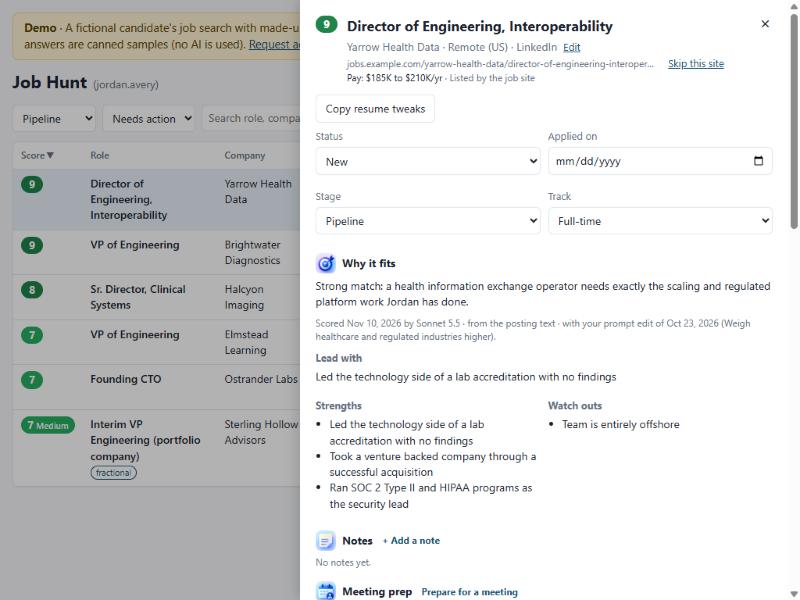
The original idea was simple: remove as much repetitive work as possible without lowering the quality of the search. I wanted an application that could evaluate each opportunity against my background, experience, and career interests, identify strong matches, highlight gaps, and explain its reasoning. I would still make the decision. I just wouldn't spend nearly as much time gathering the information to make it.
The earliest version was two Node.js scripts using Google Sheets to discover and evaluate opportunities. I later rebuilt it as a single-user application backed by SQLite, before opening it up to other users. Getting the evaluation right took real iteration. Early prompts produced assessments that sounded convincing without being useful. I refined the prompts, changed what information the model received, and kept adjusting until the evaluations matched how I would have judged the role myself. Because I used it every day, it improved quickly.
From Finding Opportunities to Preparing for Them
Once Job Hunt could find promising roles, the next step was obvious. If the application already understood my experience and a job's requirements, it could help me prepare a stronger application. That led to cover letter drafts and recommendations for tailoring my résumé. When interviews started, it added company research, meeting preparation, talking points, and likely questions. There was no grand roadmap. Each feature came from using the application and finding the next piece of repetitive work to remove.
One thing never changed: I review everything the application produces. Cover letters, résumé changes, and meeting prep notes are starting points, and I iterate on them inside the application with Claude until they say exactly what I want them to say. A separate AI fact check compares claims in each cover letter with the user's résumé and knowledge document, flagging statements that are unsupported or contradicted. The goal was never to automate my way into hundreds of generic applications. It was to spend less time on mechanics and more time making each application genuinely personal.
THE PRINCIPLE“The goal was never to automate my way into hundreds of generic applications.”
When a Great Opportunity Isn't Real
Then I ran into a different problem: postings that weren't legitimate. Some looked too good to be true. Others looked completely reasonable, with credible descriptions and companies that seemed real.
The most recent one started like any other. Job Hunt found a fractional CTO role on LinkedIn, and I applied. Someone contacted me almost immediately to set up a call, and that speed was the first thing that bothered me. As I researched the company and the person who reached out, my reservations grew. The more I dug into their LinkedIn presence, the clearer it became that this was a scam, and I canceled the call.
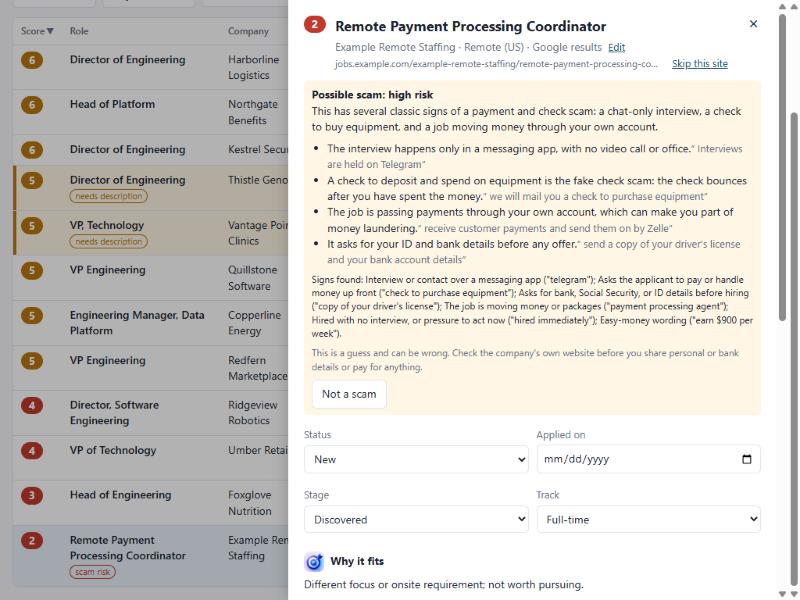
That experience shaped a new capability. Job Hunt now evaluates the legitimacy of both the posting and the person who posted it. It works in two stages. Every new job first goes through free, rule based checks for common warning signs, and only the jobs those rules flag get a closer look from an AI model. That keeps the cost low without giving up a second opinion where it matters. A warning never blocks or archives a job. It tells me what deserves a closer look before I invest more time, and I make the call. For anyone in a job search, avoiding a fraudulent opportunity is as valuable as finding a real one.
Always advisory. A warning calls attention to risk. It does not reject or archive the job.
Opening It Up to Others
Job Hunt has grown from two scripts into a multiuser application hosted on AWS. Its current production version runs TypeScript on Node.js, PostgreSQL on Amazon RDS, and a durable database-backed queue for background work. SQLite remains supported for local development. Others can request access to the production version, and I approve each account. The earlier versions are preserved in the repository history, and the current source code is available on GitHub for anyone who would rather run their own copy.
Job Hunt is free to use, and I do not intend to monetize it. Users can bring their own Claude API key and pay Anthropic directly for that usage. The application also supports administrator-provided AI access subject to per-user spending limits. Those controls help me keep the service free without allowing AI costs to grow unchecked.
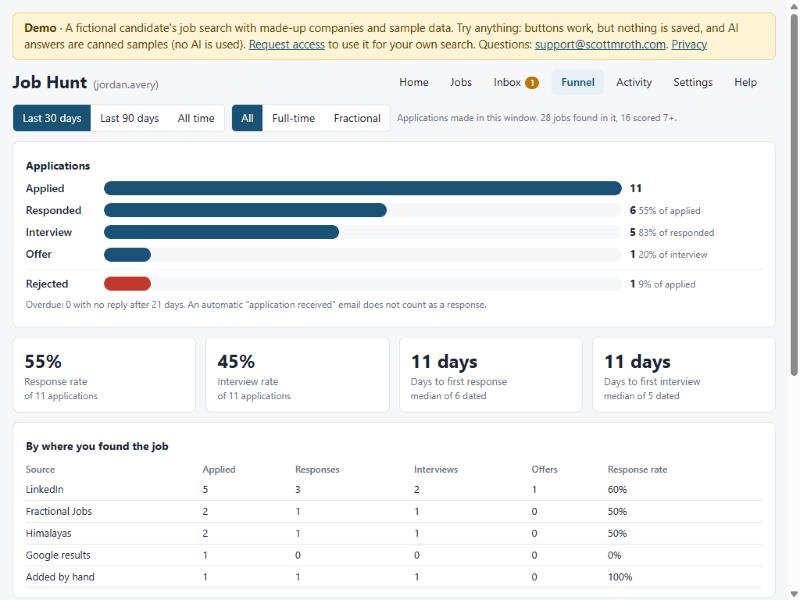
Beyond finding and preparing for opportunities, Job Hunt tracks how the search is actually going. The Funnel view shows how many applications led to responses, interviews, and offers, how long responses typically take, and which job sources produce results. It keeps the search grounded in what is working rather than how busy it feels.
How Job Hunt Protects Your Data
A job search involves a résumé, a work history, and private correspondence with recruiters and employers. Having spent much of my career in healthcare technology, most recently as Vice President of Technology and Security Officer at a clinical laboratory, I take users' privacy extremely seriously. That means two commitments: protecting their data from outsiders, and never using or selling it myself. A user's data exists to help that user find a job, and for nothing else.
Users sign in with Google. Every table that holds user data stores the owner's ID on each row, and the data layer adds the signed in user's ID to queries on that data. Automated tests fail the build if a query on a user's table leaves it out, and other tests try to reach one user's data while signed in as another to confirm nothing comes back. Even the admin screens show only account details and totals, never anyone's jobs, notes, documents, or API key.
All traffic is encrypted over HTTPS. Users' Claude API keys, stored email content, and backups are encrypted with AES 256, and once an API key is saved it is never displayed again, not even to me. Data goes to the AI model when a user runs an AI feature or when one of their scheduled runs scores jobs or drafts letters. What is sent is limited to the job postings involved and that user's own information, never another user's data, API keys, or account details. The application logs counts, never the text of prompts or responses. The scam checks use no outside lookup services, because sending users' data to another company wasn't worth the extra signal. Gmail is connected only for my own account, and the application never asks anyone else for access to their inbox.
Users stay in control. From their settings, they can download everything they own, or delete their account, which removes their account, data, and attached files right away. Copies inside the encrypted backups age out within about two months. The privacy policy is published with the source code, so anyone can see how it all works.
What Being the First User Taught Me
Two lessons stand out. First, good AI results take iteration. Useful evaluations came from refining prompts and inputs against real use, not from one clever prompt. Second, using your own software is an education. When a workflow takes too many clicks, I feel it. When a feature sounds useful but doesn't help day to day, I have a reason to question whether it belongs. I wrote more about how I approach building with AI in my previous article.
Giving Back
Throughout my career, and especially during this search, people in my network and the broader technology community have shared opportunities, made introductions, and given their time. Job Hunt is one way I can return that. This is the toughest job market I've seen in more than 30 years of working, and I want to give people who are struggling real help finding the job they deserve. It's for people looking for their dream job, and for those worn down by an endless stream of postings as they search for their next one.
I started building Job Hunt because I was spending hours on repetitive work instead of making progress. If it can give someone those hours back, help them find an opportunity they would have missed, or help them walk away from a scam before it costs them anything, the effort will have been worthwhile. Start with the public demo, which runs entirely on fictional data. If you want to use it for your own search, request access. I welcome any and all feedback, because that is how Job Hunt will keep improving.
Built from a real problem. Available to explore.
Try the Public Demo: demojobs.scottmroth.com
Request Access: jobs.scottmroth.com (accounts require my approval; AI usage has key and spending controls)
Explore the Code: github.com/scottmroth5/Job-Agent